


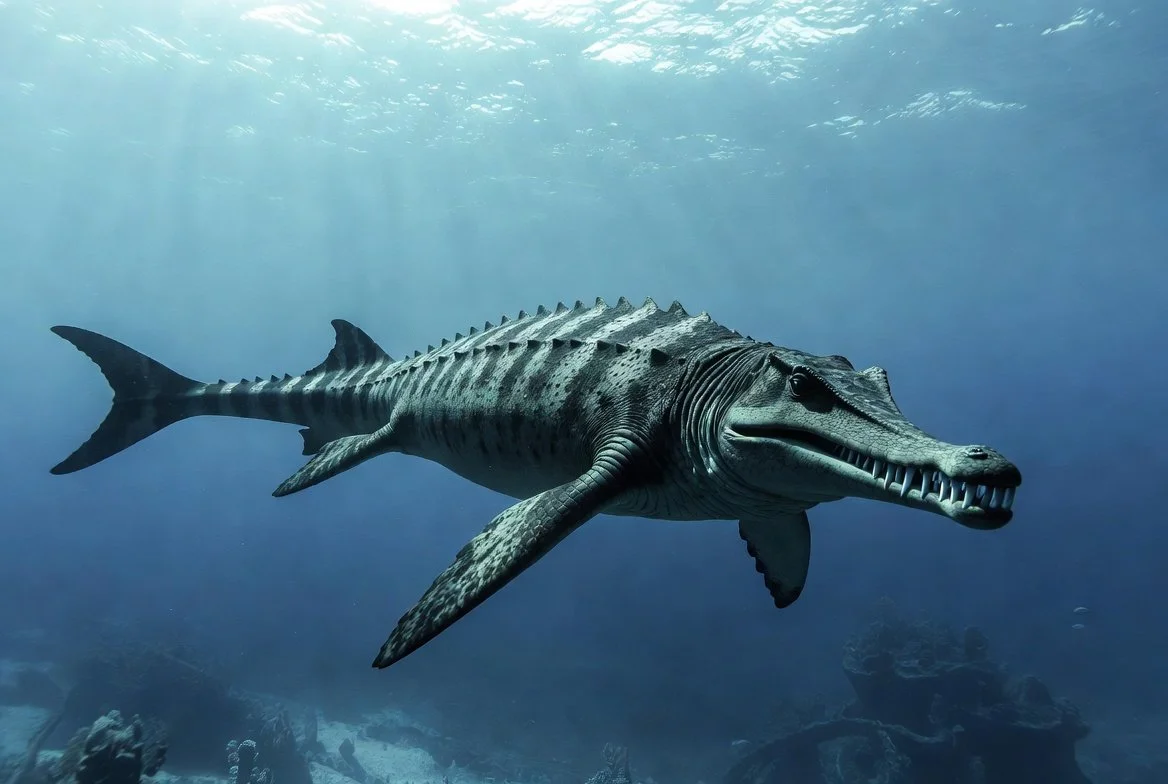
Mosasaurus
Basic Info About Mosasaurus
Mosasaurus is a genus of large extinct marine reptiles belonging to the family Mosasauridae within the order Squamata, which includes modern lizards and snakes. These creatures were not dinosaurs but highly adapted aquatic predators that dominated the oceans during the Late Cretaceous Period. The name "Mosasaurus" derives from the Meuse River (Latin: Mosa) in the Netherlands, where the first fossils were discovered in the late 18th century.
Weight
Estimates for the weight of Mosasaurus vary depending on the species and specimen size. Larger individuals, particularly of Mosasaurus hoffmannii, are thought to have weighed approximately 10 metric tons (about 11 short tons), though some older estimates suggested up to 15–20 tons for the biggest examples. Body mass calculations rely on comparisons with living animals and skeletal proportions, as only bones are preserved.
Key Features
Mosasaurus possessed a streamlined, elongated body suited for efficient swimming. Key anatomical traits include:
Robust jaws with powerful muscles and numerous large, conical teeth adapted for grasping and cutting prey.
A second row of teeth on the palate (pterygoid teeth) that helped secure struggling prey.
Four limbs modified into paddle-like flippers for steering.
A long tail with a downward bend supporting a paddle-like fluke for primary propulsion via lateral undulation.
Scaly skin, similar to that of modern reptiles.
Excellent vision and a high metabolic rate, suggesting possible endothermy (warm-bloodedness), which is rare among squamates.
These features enabled Mosasaurus to be an apex predator capable of hunting in both shallow and open waters.
Age and Temporal Range
Mosasaurus lived during the Campanian to Maastrichtian stages of the Late Cretaceous, approximately 82.7 to 66 million years ago. As part of the broader mosasaur group, these reptiles first appeared around 94 million years ago, with the lineage diversifying rapidly after the decline of other marine reptiles like ichthyosaurs. They became extinct at the end of the Cretaceous Period due to the Cretaceous-Paleogene (K-Pg) mass extinction event.
Location and Habitat
Mosasaurus inhabited a wide range of marine environments, including tropical, subtropical, temperate, and subpolar oceanic waters. Fossil evidence indicates it occupied much of the Atlantic Ocean and adjacent seaways. It likely preferred coastal and shallow marine habitats rich in prey but was capable of venturing into deeper open waters. High global sea levels during the Cretaceous facilitated its broad distribution.
Fossil Location
Fossils of Mosasaurus have been discovered on multiple continents, reflecting its extensive geographic range. Notable finds come from North America (including the Western Interior Seaway in regions now part of the United States and Canada), Europe (particularly the Netherlands, Belgium, and other areas), Africa, Western Asia, and even Antarctica. The first scientifically recognized specimens originated from chalk quarries near Maastricht in the Netherlands.
Fun Facts
Mosasaurus could reach lengths of 11–17 meters (36–56 feet), depending on the species and estimation method, making some individuals comparable in size to a modern bus.
Like snakes, mosasaurs had highly flexible jaws that could expand to swallow large prey whole.
They propelled themselves primarily with powerful tail movements rather than limb strokes, similar to modern sharks or whales in efficiency.
Mosasaurs are among the last major marine reptile groups to evolve before the end-Cretaceous extinction, representing a peak of reptilian adaptation to ocean life.
Their fossils are relatively common in certain Cretaceous deposits, such as the chalk beds of Kansas and the Pierre Shale, providing significant insights into ancient marine ecosystems