


Spinosaurus
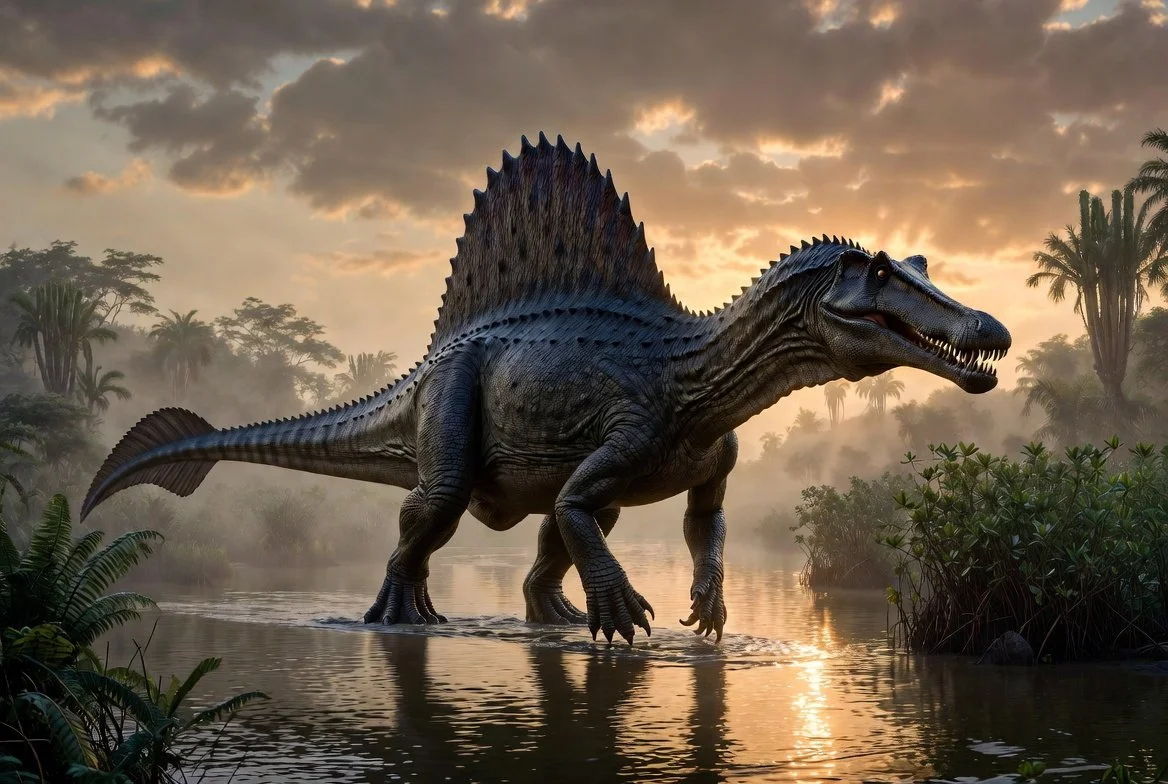
Spinosaurus (often called the “Spine Lizard”) is one of the most unusual and fascinating large carnivorous dinosaurs. It was a spinosaurid theropod known for its massive size, crocodile-like skull, and prominent sail on its back.
Basic Info About Spinosaurus:
Scientific Name: Spinosaurus aegyptiacus
Name Meaning: “Spine reptile from Egypt.”
Classification: Theropod dinosaur, member of the Spinosauridae family
Length: Approximately 46–52 feet (14–16 meters); one of the longest known carnivorous dinosaurs
Height: Around 9–11 feet (2.7–3.5 m) at the hips; sail could add significant height
Diet: Primarily piscivorous (fish-eater) but also an opportunistic hunter of other prey
Era: Late Cretaceous Period
Spinosaurus was adapted for a semiaquatic lifestyle, spending significant time in and around rivers, unlike most other large theropods.
Weight:
Modern estimates, based on 3D skeletal models and CT scans, place an adult Spinosaurus at approximately 7–8.2 metric tons (about 15,400–18,000 lbs), with a commonly cited figure of 7.4 tons. Earlier studies varied widely (from 4 to over 20 tons), but the current consensus favors the lower-to-mid range, making it longer but not necessarily heavier than T. rex.
Key Features:
Skull & Teeth: Long, narrow, crocodile-like snout (up to 5.7–6 feet / 1.75 m) with straight, conical teeth ideal for gripping slippery fish. Nostrils positioned farther back on the snout.
Sail / Neural Spines: Tall spines (up to 5.4+ feet / 1.65+ m) extending from the vertebrae, likely connected by skin to form a large sail or hump — possibly used for display, thermoregulation, or signaling.
Arms & Claws: Large, robust forelimbs with three-fingered hands and especially massive curved claws on the first digit — much stronger and more functional than T. rex arms.
Legs & Tail: Relatively short hind legs; a long, narrow tail with tall spines and elongated chevrons that formed a paddle-like structure for swimming.
Build: More slender and elongated overall compared to the robust T. rex, with adaptations for buoyancy and movement in water.
Age and Temporal Range:
Temporal Range: Lived during the Cenomanian stage of the Late Cretaceous, approximately 99–93.5 million years ago (about 5–6 million years).
Lifespan: Likely 20–30 years, similar to other large theropods.
Extinction: Disappeared millions of years before the end-Cretaceous mass extinction (along with many other dinosaurs around 66 million years ago).
Location and Habitat:
Spinosaurus fossils are found exclusively in North Africa, primarily:
Bahariya Formation (Egypt)
Kem Kem Beds (Morocco)
Other sites in Algeria, Tunisia, and possibly Niger
Habitat:
River systems, tidal flats, estuaries, mangrove forests, and coastal deltas in a warm, humid environment. It shared its ecosystem with large fish, sawfish, crocodilians, pterosaurs, and other dinosaurs.
Fun Facts:
The original fossils (discovered in 1912 in Egypt) were destroyed in 1944 during a WWII bombing raid in Munich; modern knowledge relies on newer discoveries.
Spinosaurus is considered the longest known carnivorous dinosaur.
Its tail had a unique paddle-like shape, supporting the idea of a semiaquatic lifestyle — one of the few dinosaurs clearly adapted for swimming.
The sail may have been used in mating displays, similar to how peacocks use their feathers.
Spinosaurus had a more diverse diet than once thought, including fish, smaller dinosaurs, and possibly pterosaurs.
Unlike T. rex, it had powerful arms and claws well-suited for grabbing prey or wading in water.