


Tyrannosaurus rex
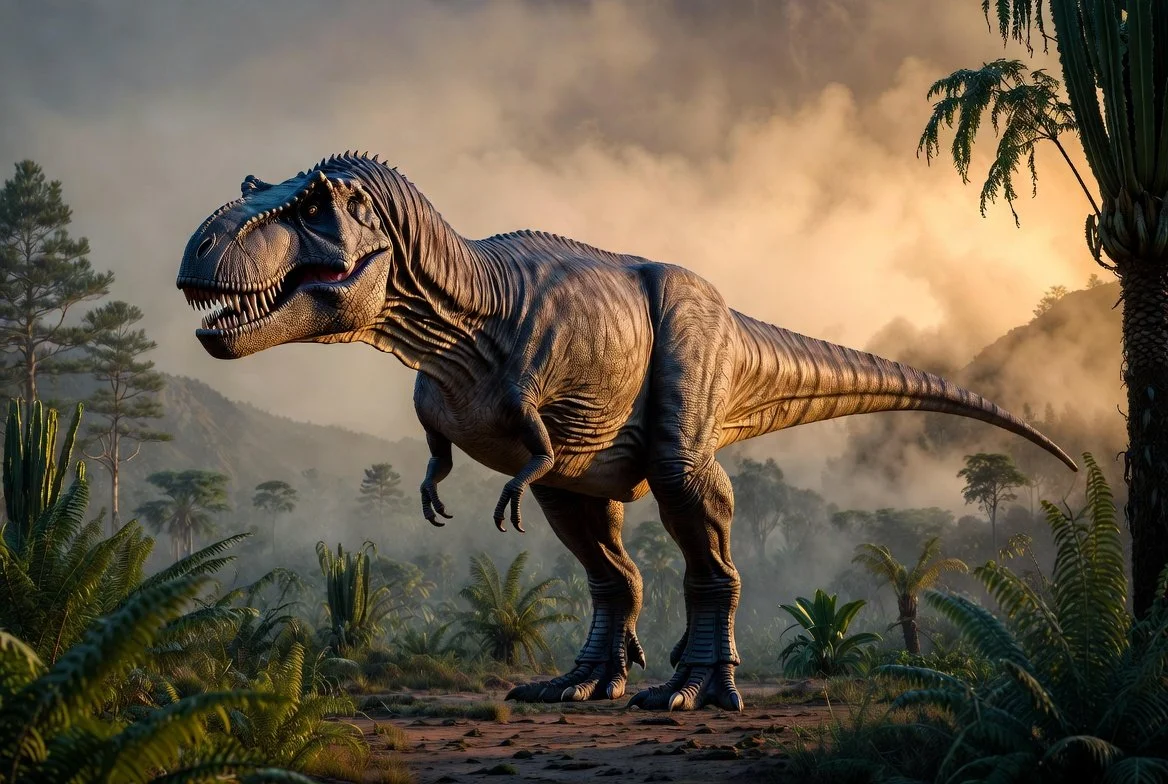
Tyrannosaurus rex (T. rex) – The Tyrant Lizard King
Basic Info About T. rex:
Scientific Name: Tyrannosaurus rex
Name Meaning: “Tyrant lizard king” (from Greek tyrannos = tyrant + saurus = lizard + Latin rex = king)
Classification: Theropod dinosaur, bipedal carnivore, member of the Tyrannosauridae family
Length: Up to 40–43 feet (12–13 meters) from snout to tail tip
Height: 12–13 feet (3.6–4 meters) at the hips
Diet: Carnivorous apex predator and opportunistic scavenger
Era: Late Cretaceous Period
T. rex was one of the largest land carnivores ever to exist and dominated western North America right up until the end of the dinosaur age.
Weight:
Modern scientific estimates place adult T. rex weight between 6 and 9 metric tons (13,000–20,000 lbs), with most robust specimens around 7–8 tons.
The famous “Scotty” specimen (one of the largest known) is estimated at approximately 8.8 metric tons (19,400 lbs). Earlier estimates were lower (around 5–7 tons), but improved skeletal reconstructions and bone density studies have revised these figures upward.
Key Features:
Skull & Bite: Enormous head (up to 5 feet / 1.5 m long) with one of the strongest bite forces of any terrestrial animal — capable of crushing bone. Teeth up to 12 inches (30 cm) long, banana-shaped and serrated.
Arms: Famously tiny forelimbs (about 3 feet / 1 m long) with two clawed fingers each. Despite their size, they were powerfully muscled and likely used for grasping during mating or to help the animal stand up.
Legs & Tail: Powerful hind legs built for walking and possibly short bursts of speed (up to ~15–25 mph). A long, heavy tail provided balance and counterweight.
Skin & Appearance: Scaly skin with a rough, textured surface. Some evidence suggests sparse proto-feathers or filamentous structures along the back and neck in juveniles or certain areas.
Senses: Large forward-facing eyes suggesting good binocular vision, a strong sense of smell, and likely excellent hearing.
Age and Temporal Range:
Temporal Range: Lived approximately 68 to 66 million years ago during the late Maastrichtian stage of the Late Cretaceous — a relatively short window of about 2 million years.
Lifespan: Individuals could live 20–30 years. Many known fossils represent animals that died between 15–25 years old. Growth was rapid: a T. rex could reach full size in about 20 years.
Extinction: Disappeared along with ~75% of all species during the Cretaceous–Paleogene (K–Pg) mass extinction event 66 million years ago, triggered by the Chicxulub asteroid impact.
Location and Habitat:
T. rex fossils are found only in western North America. Major discovery sites include:
Hell Creek Formation (Montana, North Dakota, South Dakota)
Lance Formation (Wyoming)
Scollard Formation (Alberta, Canada)
Other finds in Saskatchewan, Colorado, New Mexico, and possibly Utah
Habitat:
Warm, humid subtropical floodplains, river valleys, and coastal forests. The environment featured dense stands of conifers, ferns, cycads, and early flowering plants, with seasonal rains and abundant large herbivore prey such as Triceratops and Edmontosaurus.
Fun Facts:
The first partial T. rex skeleton was discovered in 1902 in Montana by paleontologist Barnum Brown.
“Sue,” the most complete T. rex ever found (about 90% complete), sold at auction for $8.36 million in 1997 and is now on display at the Field Museum in Chicago.
T. rex had 50–60 teeth, and it continuously replaced them throughout its life.
Bite force estimates reach up to 12,800 pounds (57,000 Newtons) — stronger than any living animal.
In popular culture, T. rex is often shown with its arms dangling uselessly, but recent studies suggest the arms were strong enough to lift several hundred pounds.
Over 50 T. rex specimens have been found, but only a few are nearly complete.
A 2021 study suggested that T. rex may have been covered in a downy coat of feathers as juveniles, which was largely lost in adulthood.