

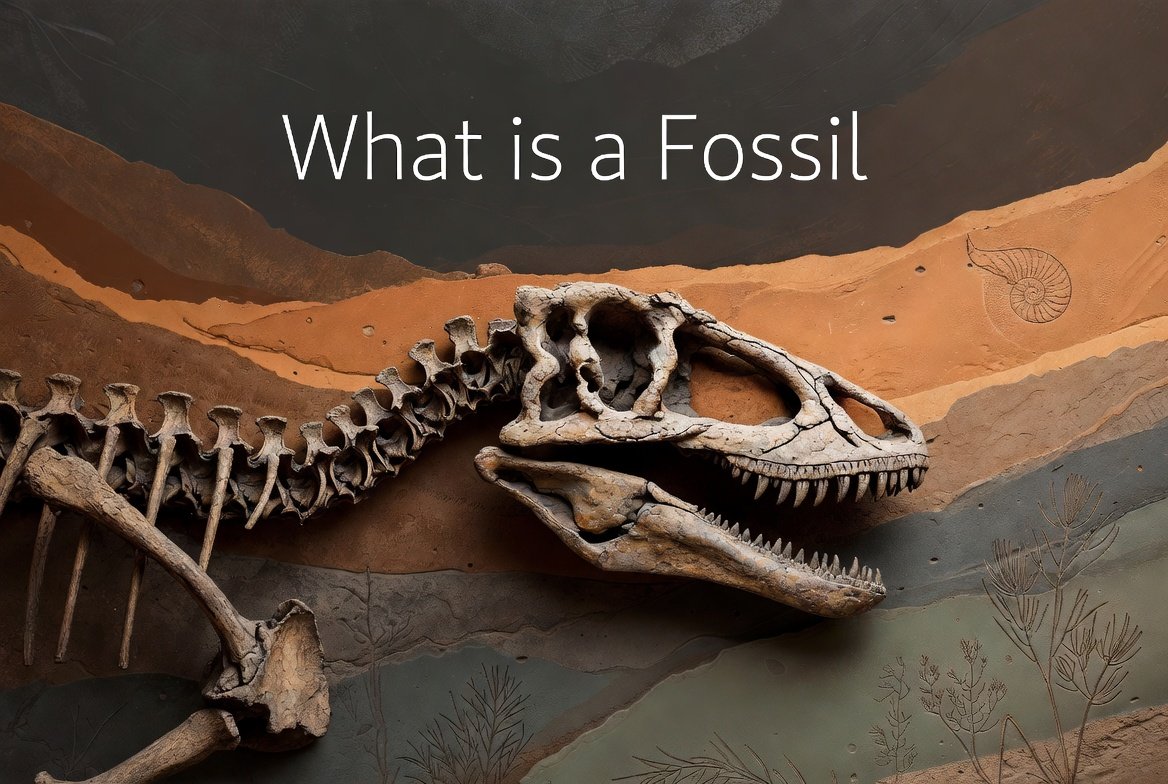
A fossil is the preserved remains, impression, or trace of a once-living organism (such as an animal, plant, or microorganism) from a past geological age. Fossils provide direct evidence of ancient life and are essential for understanding evolutionary history, past environments, and the age of rock layers. They typically form when an organism dies and is rapidly buried by sediment, protecting it from decay and scavengers. Over thousands to millions of years, minerals may replace or fill the organic material, or the surrounding sediment may harden into rock.
Fossilization is a rare process; only a tiny fraction of organisms become fossilized, as most decay completely or are destroyed.
Fossils are classified into two main categories, body fossils (remains of organisms) and trace fossils (evidence of activity)—and are preserved through processes like permineralization, molds/casts, and carbonization. Common types include petrified wood, teeth, shells, footprints, and insects trapped in amber
Main Types of Fossil Preservation
Permineralization & Replacement: Mineral-rich water fills pores in bones, shells, or wood, turning them into stone.
Molds and Casts: A mold is an impression left in sediment, while a cast is formed when sediment fills that mold to create a 3D replica.
Trace Fossils: Fossilized evidence of behavior, such as footprints, burrows, trails, and coprolites (fossilized feces).
Carbonization (Compression): An organism is buried and flattened, leaving a thin carbon film, often preserving leaves and fish.
Preserved Remains: The original organism is preserved in ice, amber (tree sap), or tar pits.
Imprints: Two-dimensional impressions left by thin objects like leaves or feathers.